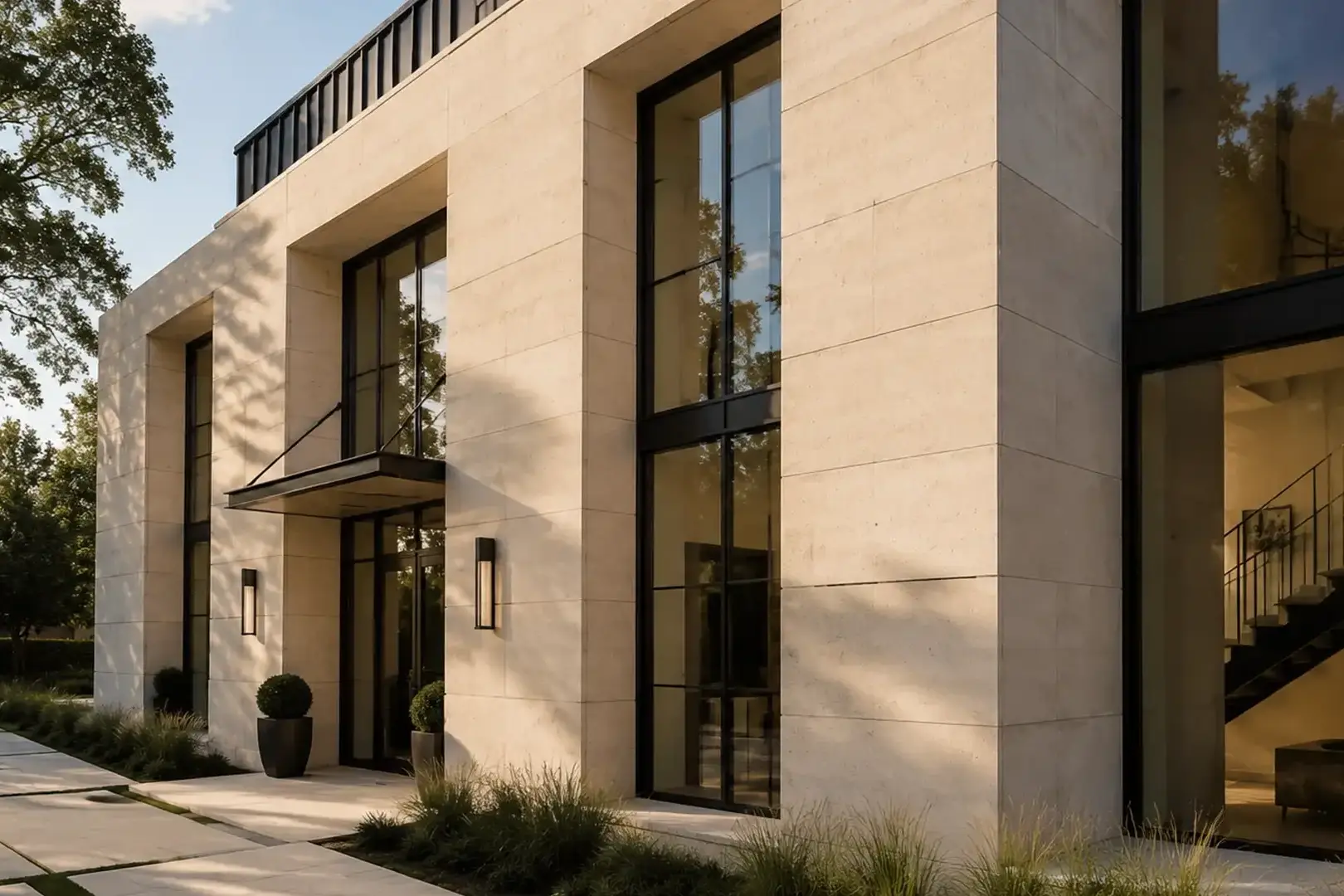
Natural Limestone vs. Cast Stone (Precast): Why Real Stone is the Better Investment
Natural Limestone vs. Cast Stone (Precast): Why Real Stone is the Better Investment
Natural limestone vs. cast stone is one of the most important comparisons homeowners, architects, and developers face when evaluating premium facade materials. At first glance, cast stone can appear to offer a similar visual result at a lower upfront cost. But when projects are examined through the lens of longevity, prestige, performance, and long-term property value, the difference becomes far more significant.
For rational buyers and developers who need solid justification for the premium, this comparison is not simply about material preference. It is about understanding what creates real architectural value—and what merely imitates it.
At Marvelous Marble, we work with clients across the United States and Canada who want to make informed decisions during the design phase. In many cases, the question is not whether cast stone can look acceptable at completion. The real question is whether it can deliver the same permanence, authenticity, and investment value as natural limestone over time.
The answer, in most high-end applications, is no.
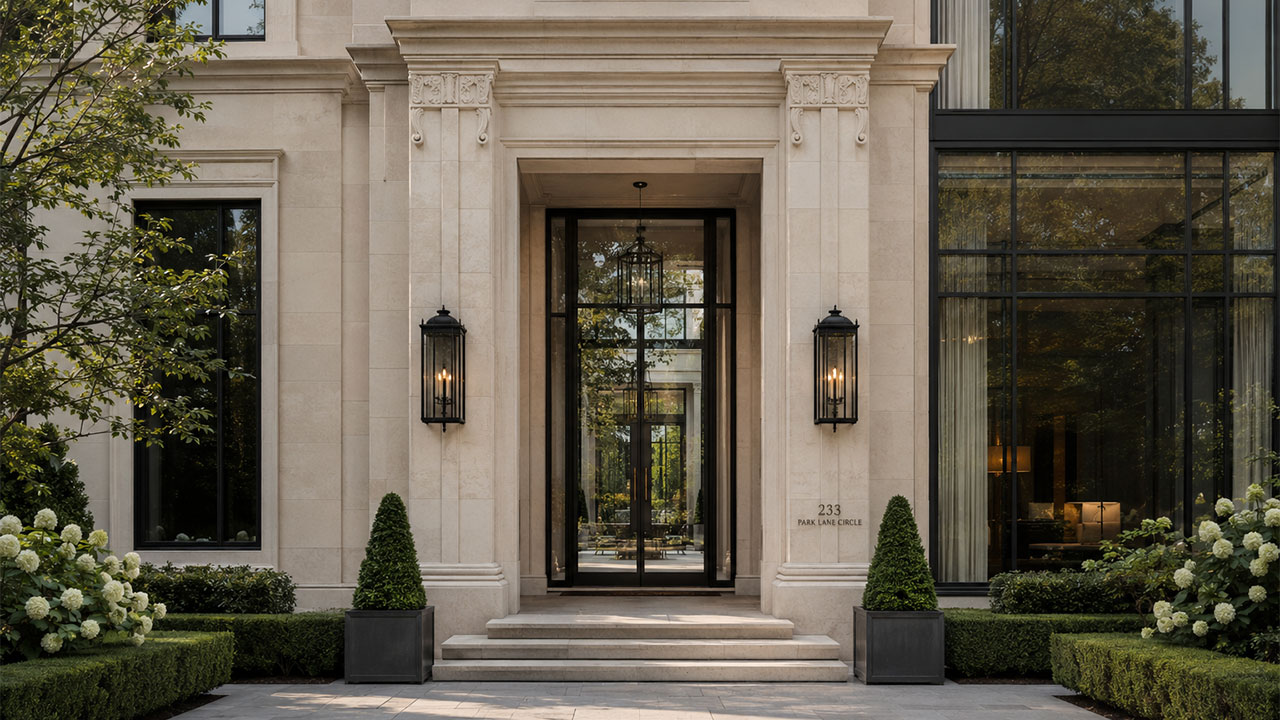
Understanding the Difference Between Natural Limestone and Cast Stone
Before comparing performance and value, it is important to define the materials clearly.
What Is Natural Limestone?
Natural limestone is a genuine quarried stone formed over millions of years. It is extracted from the earth in blocks, then cut, carved, finished, and installed for architectural use. Each piece carries the mineral depth, tonal nuance, and material integrity that only nature can produce.
Natural limestone is not manufactured to imitate anything. It is the original material.
What Is Cast Stone (Precast)?
Cast stone, often referred to as precast stone in residential discussions, is a manufactured product made from cement, aggregates, pigments, and admixtures. It is poured into molds to simulate the appearance of carved natural stone.
While modern cast stone can be visually convincing from a distance, it remains a concrete-based product designed to resemble real stone rather than actually being real stone.
That distinction matters more than many buyers initially realize.
Authenticity: Real Material Always Reads Differently
One of the strongest arguments for natural limestone is the one people often feel before they can articulate it: authenticity.
Natural limestone has:
- true mineral composition
- organic tonal variation
- natural surface depth
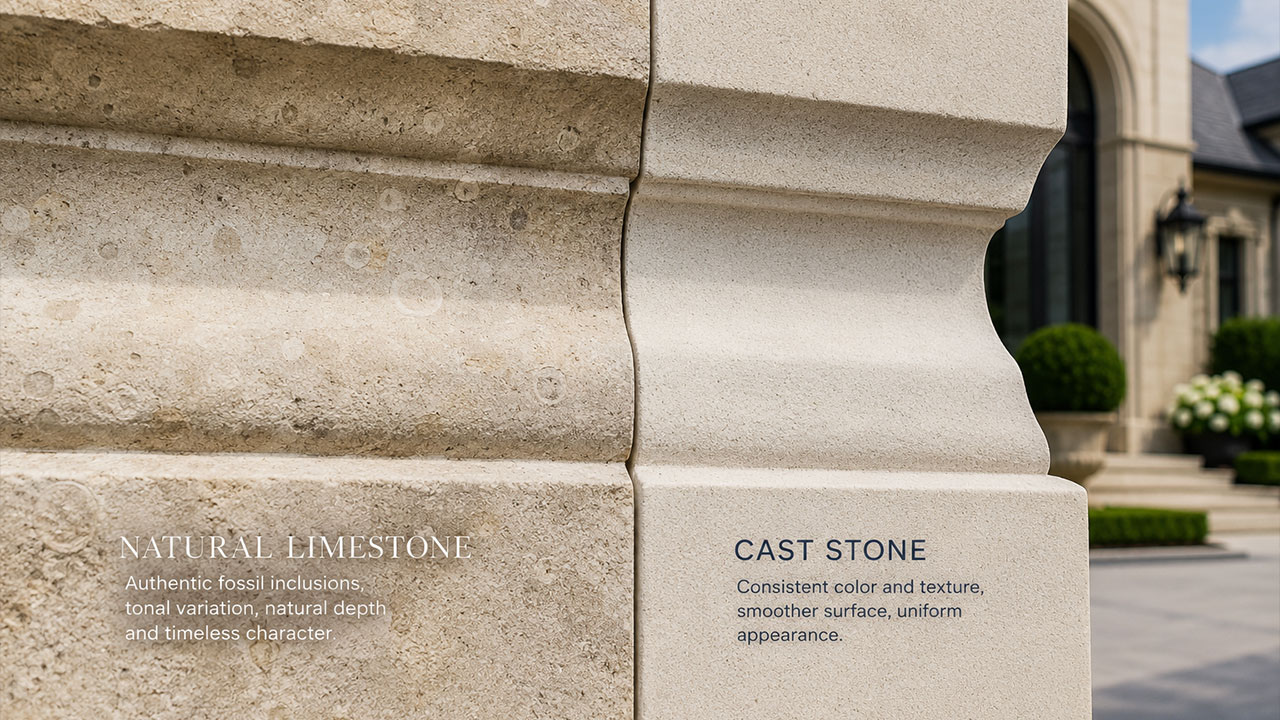
- subtle fossil and geological character
- a visual softness that manufactured materials struggle to replicate
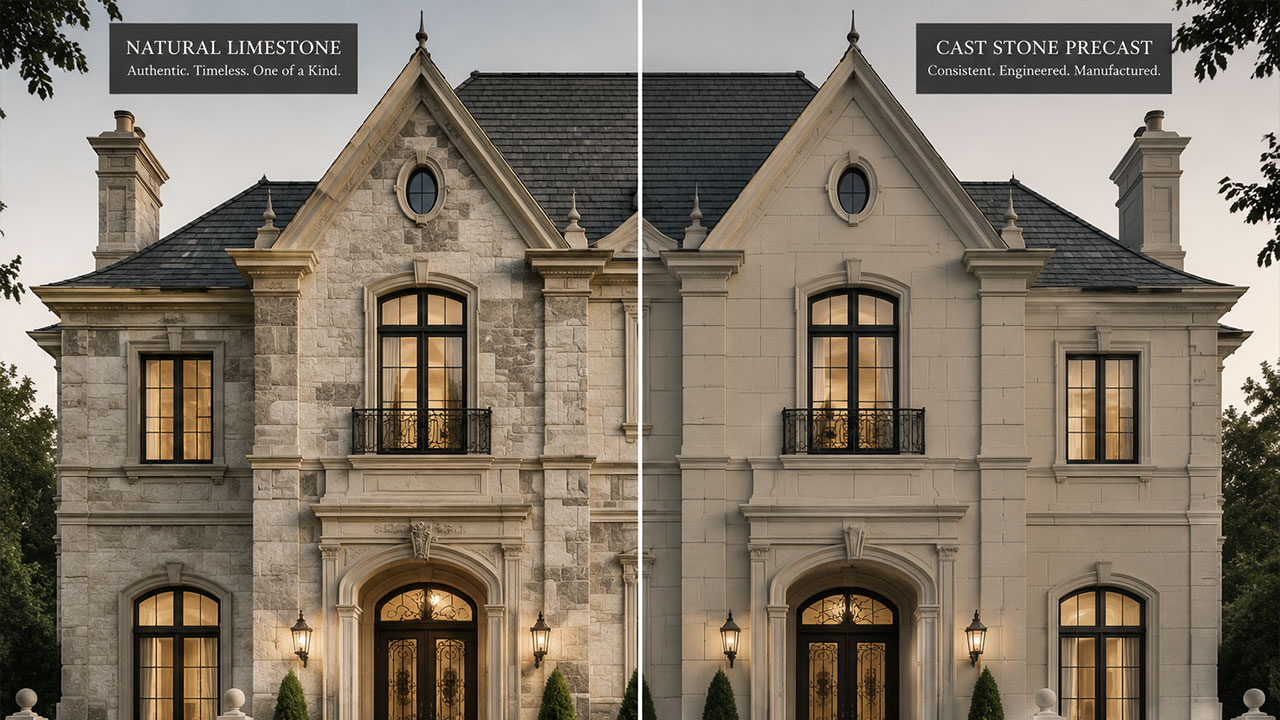
Cast stone can mimic shape, profile, and even color to a degree, but it rarely achieves the same depth of material expression. It tends to feel more uniform, flatter, and visually “controlled” in a way that gives away its manufactured origin—especially in close view, large surfaces, or luxury settings where expectations are high.
For prestige residential projects, that authenticity is not a minor detail. It is part of what makes the architecture feel credible, substantial, and expensive.
Longevity and Weathering: The Investment Perspective
If the goal is long-term value, weathering behavior is one of the most important categories in the comparison.
Natural Limestone Ages with Dignity
High-quality natural limestone develops character over time. When properly selected and detailed, it weathers in a way that is often described as graceful. The patina deepens the architectural expression rather than diminishing it.
Cast Stone Is More Vulnerable to Cosmetic Aging
Because cast stone is cement-based and pigment-controlled, it is often more susceptible to:
- surface inconsistencies over time
- patchy weathering
- color fading or variation between units
- hairline cracking
- staining patterns that can feel less natural and more irregular
Even when structurally serviceable, aging cast stone may begin to look tired sooner than natural limestone, which can affect the perceived quality of the entire property.
For developers and rational buyers, this matters because luxury value is not based on initial appearance alone. It depends heavily on how the property presents itself five, ten, and twenty years later.
Material Depth and Finish Quality
A major advantage of natural limestone is that its beauty is not just on the surface.
Because the material is consistent through the body of the stone, finishes such as honed, brushed, sandblasted, or carved profiles retain an authentic expression throughout. Chips, edge wear, and minor surface aging tend to remain visually coherent because the material is fundamentally the same inside and out.
Cast stone, by contrast, is a composite material. Its finish quality depends heavily on:
- mold quality
- batch consistency
- pigment control
- curing conditions
- production tolerances
This means visual consistency can vary from one production run to another, and the surface character may not have the same richness or integrity as quarried stone.
In premium homes, where viewers often engage with the material up close, this difference becomes very apparent.
Strength of Perception: Luxury Buyers Know the Difference
Not every market segment can justify natural limestone. But in the upper tier of residential architecture, perception has measurable economic value.
High-end buyers, architects, and design professionals tend to recognize the difference between real limestone and precast products. Even when they cannot identify it technically, they often sense it in the visual weight, edge crispness, tonal depth, and overall architectural presence.
Natural limestone communicates:
- permanence
- heritage
- craftsmanship
- material honesty
- true custom quality
Cast stone communicates something different:
- approximation
- budget control
- simulated luxury
- design intent constrained by cost
That may be acceptable for some applications. But for landmark entries, full facades, luxury estates, and long-term investment properties, the signal sent by real stone is far stronger.
Fabrication and Customization Capabilities
One misconception is that cast stone always offers more flexibility because it is mold-made. In reality, natural limestone is exceptionally versatile when handled by experienced fabricators.
Natural limestone allows for:
- custom carved surrounds
- bespoke cornices and columns
- large-format facade panels
- sculptural details
- modern minimalist profiles
- traditional and classical ornamentation
More importantly, these elements are crafted from the actual finished material—not a substitute trying to replicate another material’s identity.
Cast stone can be cost-effective for repetitive ornamental components, but it often relies on mold logic. That can create limitations when a project requires truly customized dimensions, continuous design refinement, or highly refined transitions between elements.
For one-of-a-kind luxury homes, natural limestone offers greater architectural integrity.
Maintenance and Lifecycle Economics
The cheapest material at installation is not always the least expensive material over the life of the project.
When evaluating natural limestone vs. cast stone, rational buyers should consider:
- replacement frequency
- visual aging
- repair complexity
- resale impact
- long-term brand or estate perception
Upfront Cost vs. Lifetime Value
Cast stone often wins on initial budget. That is the core reason it is chosen.
But natural limestone often wins on:
- lifespan
- premium appearance retention
- lower risk of aesthetic obsolescence
- stronger impact on property value
- reduced need for premature replacement to maintain luxury standards
In other words, cast stone can be cheaper to buy, but natural limestone is often cheaper to regret less.
Structural and Climatic Considerations
In the United States and Canada, climate performance matters. Freeze-thaw cycles, moisture exposure, and regional weathering conditions all affect facade longevity.
Natural limestone, when correctly selected and detailed for the application, performs exceptionally well in many North American climates. Proper anchoring systems, drainage detailing, and finish selection are essential—but that is true for any serious facade material.
Cast stone can also perform well when manufactured and installed correctly. However, because it is a cementitious product, its behavior over time can be more dependent on manufacturing quality control and mix consistency.
For developers managing multiple risk factors, that variability can become a concern—particularly on high-visibility elevations where appearance is part of the asset value.
Appraisal, Brand Positioning, and Market Differentiation
This is the category many developers underestimate.
In high-end real estate, materials help position the property in the market. Natural limestone strengthens that positioning in a way cast stone rarely can.
Why? Because real materials create real differentiation.
A property marketed with:
- authentic limestone facade
- custom limestone entry
- hand-finished natural stone detailing
has a stronger story than one described with molded precast features designed to simulate stone.
That story matters in:
- luxury resale listings
- developer branding
- buyer confidence
- architectural press and portfolio positioning
- neighborhood prestige
Natural limestone is not just a construction choice. It is a market signal.
When Cast Stone May Still Make Sense
To be objective, cast stone is not without merit.
It can be a practical option for:
- tighter budgets
- secondary buildings
- less visible elevations
- repetitive trim programs
- projects where cost efficiency outweighs authenticity
But that is exactly the point: it is often a compromise tool, not the premium benchmark.
For buyers or developers aiming to create a standout residence, a legacy property, or a luxury development with genuine architectural credibility, natural limestone remains the superior investment.
 Conclusion: Why Real Stone Justifies the Premium
 Conclusion: Why Real Stone Justifies the Premium
Natural limestone vs. cast stone is ultimately a question of what kind of project you are building—and what kind of value you expect that project to hold over time.
If the priority is minimizing upfront cost, cast stone may appear attractive. But if the priority is authenticity, prestige, longevity, weathering quality, and long-term real estate value, natural limestone offers a level of return that manufactured alternatives simply cannot replicate.
Real stone is not just more expensive material. It is more meaningful material.
For rational buyers and developers, that distinction is the justification.
At Marvelous Marble, we help clients evaluate these decisions with clarity, balancing design ambition, technical performance, and long-term investment logic. When the goal is to build something lasting, natural limestone remains the better choice.
Natural limestone vs. cast stone is one of the most important comparisons homeowners, architects, and developers face when evaluating premium facade materials. At first glance, cast stone can appear to offer a similar visual result at a lower upfront cost. But when projects are examined through the lens of longevity, prestige, performance, and long-term property value, the difference becomes far more significant.
For rational buyers and developers who need solid justification for the premium, this comparison is not simply about material preference. It is about understanding what creates real architectural value—and what merely imitates it.
At Marvelous Marble, we work with clients across the United States and Canada who want to make informed decisions during the design phase. In many cases, the question is not whether cast stone can look acceptable at completion. The real question is whether it can deliver the same permanence, authenticity, and investment value as natural limestone over time.
The answer, in most high-end applications, is no.
Understanding the Difference Between Natural Limestone and Cast Stone
Before comparing performance and value, it is important to define the materials clearly.
What Is Natural Limestone?
Natural limestone is a genuine quarried stone formed over millions of years. It is extracted from the earth in blocks, then cut, carved, finished, and installed for architectural use. Each piece carries the mineral depth, tonal nuance, and material integrity that only nature can produce.
Natural limestone is not manufactured to imitate anything. It is the original material.
What Is Cast Stone (Precast)?
Cast stone, often referred to as precast stone in residential discussions, is a manufactured product made from cement, aggregates, pigments, and admixtures. It is poured into molds to simulate the appearance of carved natural stone.
While modern cast stone can be visually convincing from a distance, it remains a concrete-based product designed to resemble real stone rather than actually being real stone.
That distinction matters more than many buyers initially realize.
Authenticity: Real Material Always Reads Differently
One of the strongest arguments for natural limestone is the one people often feel before they can articulate it: authenticity.
Natural limestone has:
- true mineral composition
- organic tonal variation
- natural surface depth
- subtle fossil and geological character
- a visual softness that manufactured materials struggle to replicate
Cast stone can mimic shape, profile, and even color to a degree, but it rarely achieves the same depth of material expression. It tends to feel more uniform, flatter, and visually “controlled” in a way that gives away its manufactured origin—especially in close view, large surfaces, or luxury settings where expectations are high.
For prestige residential projects, that authenticity is not a minor detail. It is part of what makes the architecture feel credible, substantial, and expensive.
Longevity and Weathering: The Investment Perspective
If the goal is long-term value, weathering behavior is one of the most important categories in the comparison.
Natural Limestone Ages with Dignity
High-quality natural limestone develops character over time. When properly selected and detailed, it weathers in a way that is often described as graceful. The patina deepens the architectural expression rather than diminishing it.
Cast Stone Is More Vulnerable to Cosmetic Aging
Because cast stone is cement-based and pigment-controlled, it is often more susceptible to:
- surface inconsistencies over time
- patchy weathering
- color fading or variation between units
- hairline cracking
- staining patterns that can feel less natural and more irregular
Even when structurally serviceable, aging cast stone may begin to look tired sooner than natural limestone, which can affect the perceived quality of the entire property.
For developers and rational buyers, this matters because luxury value is not based on initial appearance alone. It depends heavily on how the property presents itself five, ten, and twenty years later.
Material Depth and Finish Quality
A major advantage of natural limestone is that its beauty is not just on the surface.
Because the material is consistent through the body of the stone, finishes such as honed, brushed, sandblasted, or carved profiles retain an authentic expression throughout. Chips, edge wear, and minor surface aging tend to remain visually coherent because the material is fundamentally the same inside and out.
Cast stone, by contrast, is a composite material. Its finish quality depends heavily on:
- mold quality
- batch consistency
- pigment control
- curing conditions
- production tolerances
This means visual consistency can vary from one production run to another, and the surface character may not have the same richness or integrity as quarried stone.
In premium homes, where viewers often engage with the material up close, this difference becomes very apparent.
Strength of Perception: Luxury Buyers Know the Difference
Not every market segment can justify natural limestone. But in the upper tier of residential architecture, perception has measurable economic value.
High-end buyers, architects, and design professionals tend to recognize the difference between real limestone and precast products. Even when they cannot identify it technically, they often sense it in the visual weight, edge crispness, tonal depth, and overall architectural presence.
Natural limestone communicates:
- permanence
- heritage
- craftsmanship
- material honesty
- true custom quality
Cast stone communicates something different:
- approximation
- budget control
- simulated luxury
- design intent constrained by cost
That may be acceptable for some applications. But for landmark entries, full facades, luxury estates, and long-term investment properties, the signal sent by real stone is far stronger.
Fabrication and Customization Capabilities
One misconception is that cast stone always offers more flexibility because it is mold-made. In reality, natural limestone is exceptionally versatile when handled by experienced fabricators.
Natural limestone allows for:
- custom carved surrounds
- bespoke cornices and columns
- large-format facade panels
- sculptural details
- modern minimalist profiles
- traditional and classical ornamentation
More importantly, these elements are crafted from the actual finished material—not a substitute trying to replicate another material’s identity.
Cast stone can be cost-effective for repetitive ornamental components, but it often relies on mold logic. That can create limitations when a project requires truly customized dimensions, continuous design refinement, or highly refined transitions between elements.
For one-of-a-kind luxury homes, natural limestone offers greater architectural integrity.
Maintenance and Lifecycle Economics
The cheapest material at installation is not always the least expensive material over the life of the project.
When evaluating natural limestone vs. cast stone, rational buyers should consider:
- replacement frequency
- visual aging
- repair complexity
- resale impact
- long-term brand or estate perception
Upfront Cost vs. Lifetime Value
Cast stone often wins on initial budget. That is the core reason it is chosen.
But natural limestone often wins on:
- lifespan
- premium appearance retention
- lower risk of aesthetic obsolescence
- stronger impact on property value
- reduced need for premature replacement to maintain luxury standards
In other words, cast stone can be cheaper to buy, but natural limestone is often cheaper to regret less.
Structural and Climatic Considerations
In the United States and Canada, climate performance matters. Freeze-thaw cycles, moisture exposure, and regional weathering conditions all affect facade longevity.
Natural limestone, when correctly selected and detailed for the application, performs exceptionally well in many North American climates. Proper anchoring systems, drainage detailing, and finish selection are essential—but that is true for any serious facade material.
Cast stone can also perform well when manufactured and installed correctly. However, because it is a cementitious product, its behavior over time can be more dependent on manufacturing quality control and mix consistency.
For developers managing multiple risk factors, that variability can become a concern—particularly on high-visibility elevations where appearance is part of the asset value.
Appraisal, Brand Positioning, and Market Differentiation
This is the category many developers underestimate.
In high-end real estate, materials help position the property in the market. Natural limestone strengthens that positioning in a way cast stone rarely can.
Why? Because real materials create real differentiation.
A property marketed with:
- authentic limestone facade
- custom limestone entry
- hand-finished natural stone detailing
has a stronger story than one described with molded precast features designed to simulate stone.
That story matters in:
- luxury resale listings
- developer branding
- buyer confidence
- architectural press and portfolio positioning
- neighborhood prestige
Natural limestone is not just a construction choice. It is a market signal.
When Cast Stone May Still Make Sense
To be objective, cast stone is not without merit.
It can be a practical option for:
- tighter budgets
- secondary buildings
- less visible elevations
- repetitive trim programs
- projects where cost efficiency outweighs authenticity
But that is exactly the point: it is often a compromise tool, not the premium benchmark.
For buyers or developers aiming to create a standout residence, a legacy property, or a luxury development with genuine architectural credibility, natural limestone remains the superior investment.
Conclusion: Why Real Stone Justifies the Premium
Natural limestone vs. cast stone is ultimately a question of what kind of project you are building—and what kind of value you expect that project to hold over time.
If the priority is minimizing upfront cost, cast stone may appear attractive. But if the priority is authenticity, prestige, longevity, weathering quality, and long-term real estate value, natural limestone offers a level of return that manufactured alternatives simply cannot replicate.
Real stone is not just more expensive material. It is more meaningful material.
For rational buyers and developers, that distinction is the justification.
At Marvelous Marble, we help clients evaluate these decisions with clarity, balancing design ambition, technical performance, and long-term investment logic. When the goal is to build something lasting, natural limestone remains the better choice.

Related Posts
Specifying Limestone Façades for Freeze–Thaw Climates: An Architect’s Guide
A technical planning guide for luxury limestone façades in New York, Chicago…