
Classical Marble Columns: Doric, Ionic or Corinthian for Your Home?
Classical Marble Columns: Doric, Ionic or Corinthian for Your Home?
A marble column does more than hold up a portico. In a grand entry, a double-height living room or a colonnaded terrace, it sets the architectural tone before a guest takes a single step inside. But the first decision is rarely “marble or not.” It is which order: Doric, Ionic or Corinthian. Each carries a different character, proportion and level of ornament, and choosing the wrong one can make even beautiful stone feel out of place.
This guide walks through the three classical orders, how they behave in a residential setting, and how to match one to your home.
A Quick Primer: What Is a Classical Order?
A classical order is a complete system of proportions for a column and the elements it supports. Every column has three parts:
- Base – the foundation the shaft rests on (some Doric columns omit it).
- Shaft – the long vertical body, smooth or fluted.
- Capital – the decorated top that transitions into the beam (entablature) above.
The capital is the easiest way to tell the orders apart, and it also drives the overall personality of the column.
Doric: Strength and Restraint
Look: A plain, rounded capital with minimal decoration. The shaft is sturdy and often fluted, with a more massive, grounded presence.
Proportion: The shortest and stockiest of the three orders.
Best for:
- Modern-classical and transitional homes that want gravitas without ornament
- Exterior porticos, porte-cochères and covered terraces
- Spaces where the stone itself, rather than carving, should be the star
Marble tip: Because the Doric order relies on clean lines, the veining and finish of the marble become the main visual feature. A honed or lightly polished finish in a uniform stone shows off the form beautifully.
Ionic: Balance and Refinement
Look: A capital with two scrolls (volutes) on each side. The shaft is more slender than Doric, usually with deeper fluting.
Proportion: Taller and more graceful than Doric, but less ornate than Corinthian.
Best for:
- Traditional and Georgian-inspired residences
- Interior foyers, libraries and formal dining rooms
- Homeowners who want visible craftsmanship without full decoration
Marble tip: The volutes are carved in fine detail, so a close-grained, consistent marble gives crisp edges and keeps the scrolls sharp over time.
Corinthian: Grandeur and Ornament
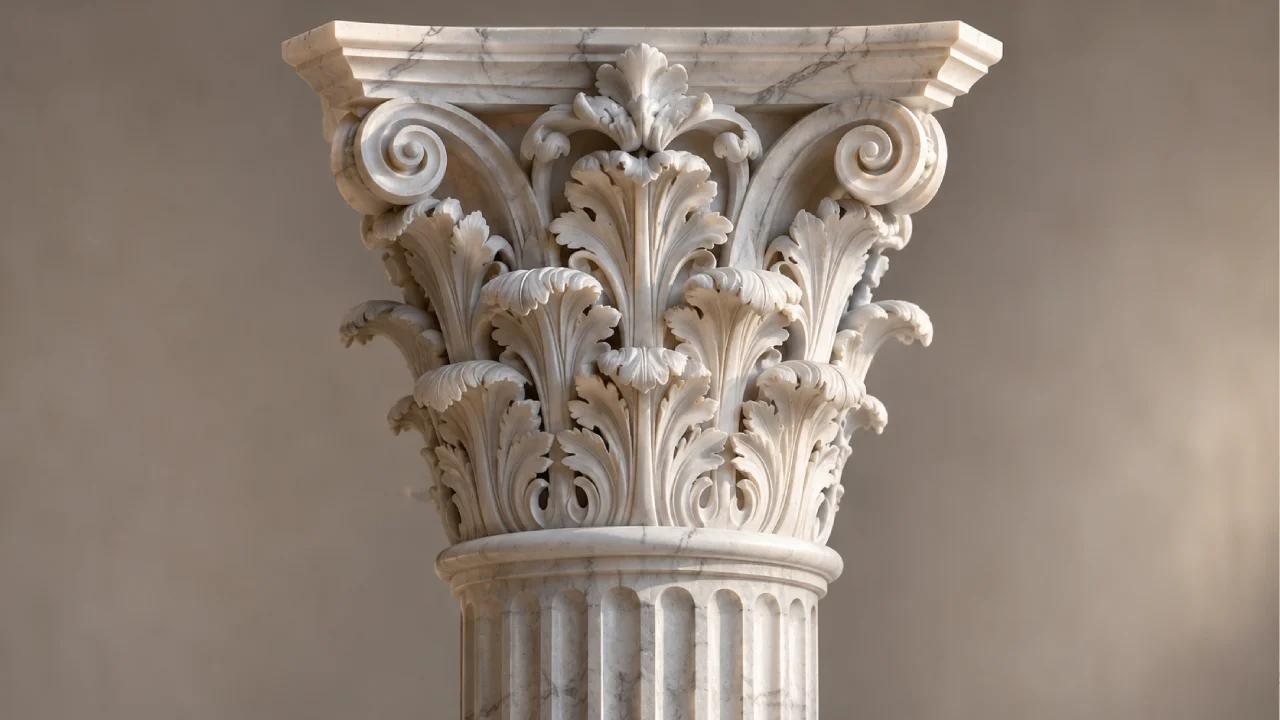
Look: A tall capital carved with acanthus leaves, often with small scrolls at the corners. It is the most elaborate of the three.
Proportion: The tallest and slimmest, suited to generous ceiling heights.
Best for:
- Neoclassical estates, formal ballrooms and grand entrance halls
- Statement façades where the home is meant to impress from the street
- Projects that already feature rich details such as medallion floors, ornate mantels or a curved staircase
Marble tip: Corinthian capitals involve the most carving hours, so lead time and budget are higher. They reward the investment with strong shadow play and a distinctly luxurious look.
At a Glance
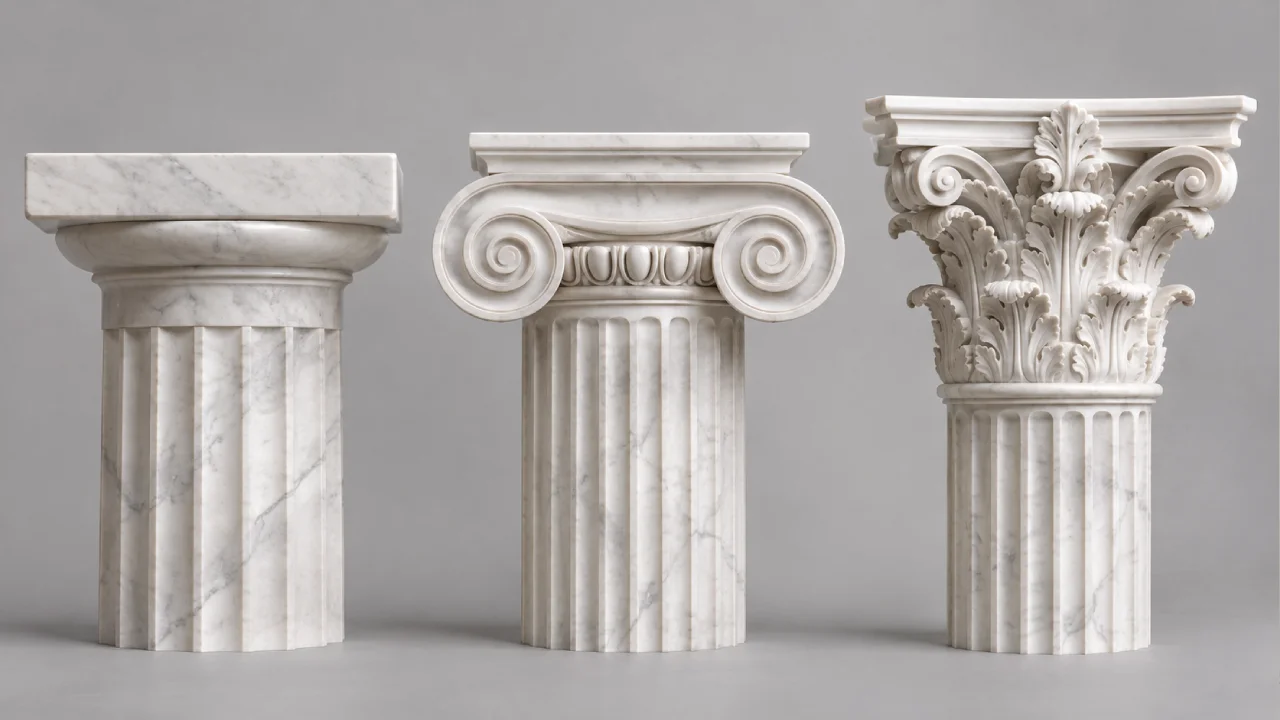
| Doric | Ionic | Corinthian | |
|---|---|---|---|
| Capital | Plain, rounded | Scrolls (volutes) | Acanthus leaves |
| Character | Strong, restrained | Elegant, balanced | Ornate, grand |
| Proportion | Short and sturdy | Medium, graceful | Tall and slender |
| Typical home style | Transitional, modern-classical | Traditional, Georgian | Neoclassical, estate |
| Carving complexity | Low | Medium | High |
How to Choose: Five Practical Questions
1. What is your ceiling or portico height? Taller spaces suit slimmer, more ornate columns. A low entry with a heavy Corinthian capital will look cramped; a Doric or simple Ionic usually sits better.
2. What is the architectural style of the home? Match the order to the house. A neoclassical façade invites Corinthian; a contemporary home with classical touches often works best with Doric.
3. Is the column structural or decorative? Some columns carry real loads; others are cladding around a steel or concrete core. This affects the engineering, the wall thickness of the stone and the installation method. Your architect and stone fabricator should settle this at the design stage.
4. Interior or exterior? Exterior columns face weather, temperature swings and, in cold regions, freeze–thaw cycles. Stone selection, sealing and detailing should reflect that. Interior columns have more freedom in finish and stone choice.
5. What else is in the room? Columns should echo the rest of the design. Pair them with matching baseboards, a marble floor border, or a mantel carved in the same language, so the space reads as one composition.
Choosing the Right Marble
The stone you choose changes how the order reads:
- White and light marbles emphasize form, shadow and carved detail.
- Veined marbles add movement and drama, but veining that runs unevenly across a tall shaft needs careful book-matching and selection.
- Warm-toned stones feel traditional and inviting in entry halls.
Always review physical samples and, for large shafts, ask to see slabs or blocks from the same lot so color and veining remain consistent from base to capital.
Common Mistakes to Avoid
- Mixing orders without intent. Using different orders in one space can look accidental unless it follows a deliberate hierarchy.
- Ignoring proportion. A column that is too thick or too thin for its height feels “off” even when the carving is flawless.
- Treating the capital as an afterthought. The capital defines the order; it deserves as much attention as the shaft.
- Leaving installation planning too late. Heavy stone elements need crane access, structural support and a clear delivery path.
Working With a Custom Stone Fabricator
A good fabricator turns drawings into stone: producing shop drawings, advising on stone selection, carving the capitals, and coordinating delivery and installation. Sharing your ceiling heights, floor plans, elevations and style references early helps the team recommend the right order and proportions before any stone is cut.
Final Thoughts
Doric, Ionic and Corinthian are not simply “simple, medium and fancy.” Each expresses a different idea of luxury: strength, harmony or splendor. Choose the one that fits your architecture and the way you want the space to feel, and a marble column becomes a lasting architectural signature rather than just decoration.
Planning columns for a new build or renovation? Contact Marvelous Marble to discuss custom marble columns, from classical orders to fully bespoke designs.
A marble column does more than hold up a portico. In a grand entry, a double-height living room or a colonnaded terrace, it sets the architectural tone before a guest takes a single step inside. But the first decision is rarely “marble or not.” It is which order: Doric, Ionic or Corinthian. Each carries a different character, proportion and level of ornament, and choosing the wrong one can make even beautiful stone feel out of place.
This guide walks through the three classical orders, how they behave in a residential setting, and how to match one to your home.
A Quick Primer: What Is a Classical Order?
A classical order is a complete system of proportions for a column and the elements it supports. Every column has three parts:
- Base – the foundation the shaft rests on (some Doric columns omit it).
- Shaft – the long vertical body, smooth or fluted.
- Capital – the decorated top that transitions into the beam (entablature) above.
The capital is the easiest way to tell the orders apart, and it also drives the overall personality of the column.
Doric: Strength and Restraint
Look: A plain, rounded capital with minimal decoration. The shaft is sturdy and often fluted, with a more massive, grounded presence.
Proportion: The shortest and stockiest of the three orders.
Best for:
- Modern-classical and transitional homes that want gravitas without ornament
- Exterior porticos, porte-cochères and covered terraces
- Spaces where the stone itself, rather than carving, should be the star
Marble tip: Because the Doric order relies on clean lines, the veining and finish of the marble become the main visual feature. A honed or lightly polished finish in a uniform stone shows off the form beautifully.
Ionic: Balance and Refinement
Look: A capital with two scrolls (volutes) on each side. The shaft is more slender than Doric, usually with deeper fluting.
Proportion: Taller and more graceful than Doric, but less ornate than Corinthian.
Best for:
- Traditional and Georgian-inspired residences
- Interior foyers, libraries and formal dining rooms
- Homeowners who want visible craftsmanship without full decoration
Marble tip: The volutes are carved in fine detail, so a close-grained, consistent marble gives crisp edges and keeps the scrolls sharp over time.
Corinthian: Grandeur and Ornament
Look: A tall capital carved with acanthus leaves, often with small scrolls at the corners. It is the most elaborate of the three.
Proportion: The tallest and slimmest, suited to generous ceiling heights.
Best for:
- Neoclassical estates, formal ballrooms and grand entrance halls
- Statement façades where the home is meant to impress from the street
- Projects that already feature rich details such as medallion floors, ornate mantels or a curved staircase
Marble tip: Corinthian capitals involve the most carving hours, so lead time and budget are higher. They reward the investment with strong shadow play and a distinctly luxurious look.
At a Glance
| Doric | Ionic | Corinthian | |
|---|---|---|---|
| Capital | Plain, rounded | Scrolls (volutes) | Acanthus leaves |
| Character | Strong, restrained | Elegant, balanced | Ornate, grand |
| Proportion | Short and sturdy | Medium, graceful | Tall and slender |
| Typical home style | Transitional, modern-classical | Traditional, Georgian | Neoclassical, estate |
| Carving complexity | Low | Medium | High |
How to Choose: Five Practical Questions
1. What is your ceiling or portico height? Taller spaces suit slimmer, more ornate columns. A low entry with a heavy Corinthian capital will look cramped; a Doric or simple Ionic usually sits better.
2. What is the architectural style of the home? Match the order to the house. A neoclassical façade invites Corinthian; a contemporary home with classical touches often works best with Doric.
3. Is the column structural or decorative? Some columns carry real loads; others are cladding around a steel or concrete core. This affects the engineering, the wall thickness of the stone and the installation method. Your architect and stone fabricator should settle this at the design stage.
4. Interior or exterior? Exterior columns face weather, temperature swings and, in cold regions, freeze–thaw cycles. Stone selection, sealing and detailing should reflect that. Interior columns have more freedom in finish and stone choice.
5. What else is in the room? Columns should echo the rest of the design. Pair them with matching baseboards, a marble floor border, or a mantel carved in the same language, so the space reads as one composition.
Choosing the Right Marble
The stone you choose changes how the order reads:
- White and light marbles emphasize form, shadow and carved detail.
- Veined marbles add movement and drama, but veining that runs unevenly across a tall shaft needs careful book-matching and selection.
- Warm-toned stones feel traditional and inviting in entry halls.
Always review physical samples and, for large shafts, ask to see slabs or blocks from the same lot so color and veining remain consistent from base to capital.
Common Mistakes to Avoid
- Mixing orders without intent. Using different orders in one space can look accidental unless it follows a deliberate hierarchy.
- Ignoring proportion. A column that is too thick or too thin for its height feels “off” even when the carving is flawless.
- Treating the capital as an afterthought. The capital defines the order; it deserves as much attention as the shaft.
- Leaving installation planning too late. Heavy stone elements need crane access, structural support and a clear delivery path.
Working With a Custom Stone Fabricator
A good fabricator turns drawings into stone: producing shop drawings, advising on stone selection, carving the capitals, and coordinating delivery and installation. Sharing your ceiling heights, floor plans, elevations and style references early helps the team recommend the right order and proportions before any stone is cut.
Final Thoughts
Doric, Ionic and Corinthian are not simply “simple, medium and fancy.” Each expresses a different idea of luxury: strength, harmony or splendor. Choose the one that fits your architecture and the way you want the space to feel, and a marble column becomes a lasting architectural signature rather than just decoration.
Planning columns for a new build or renovation? Contact Marvelous Marble to discuss custom marble columns, from classical orders to fully bespoke designs.


