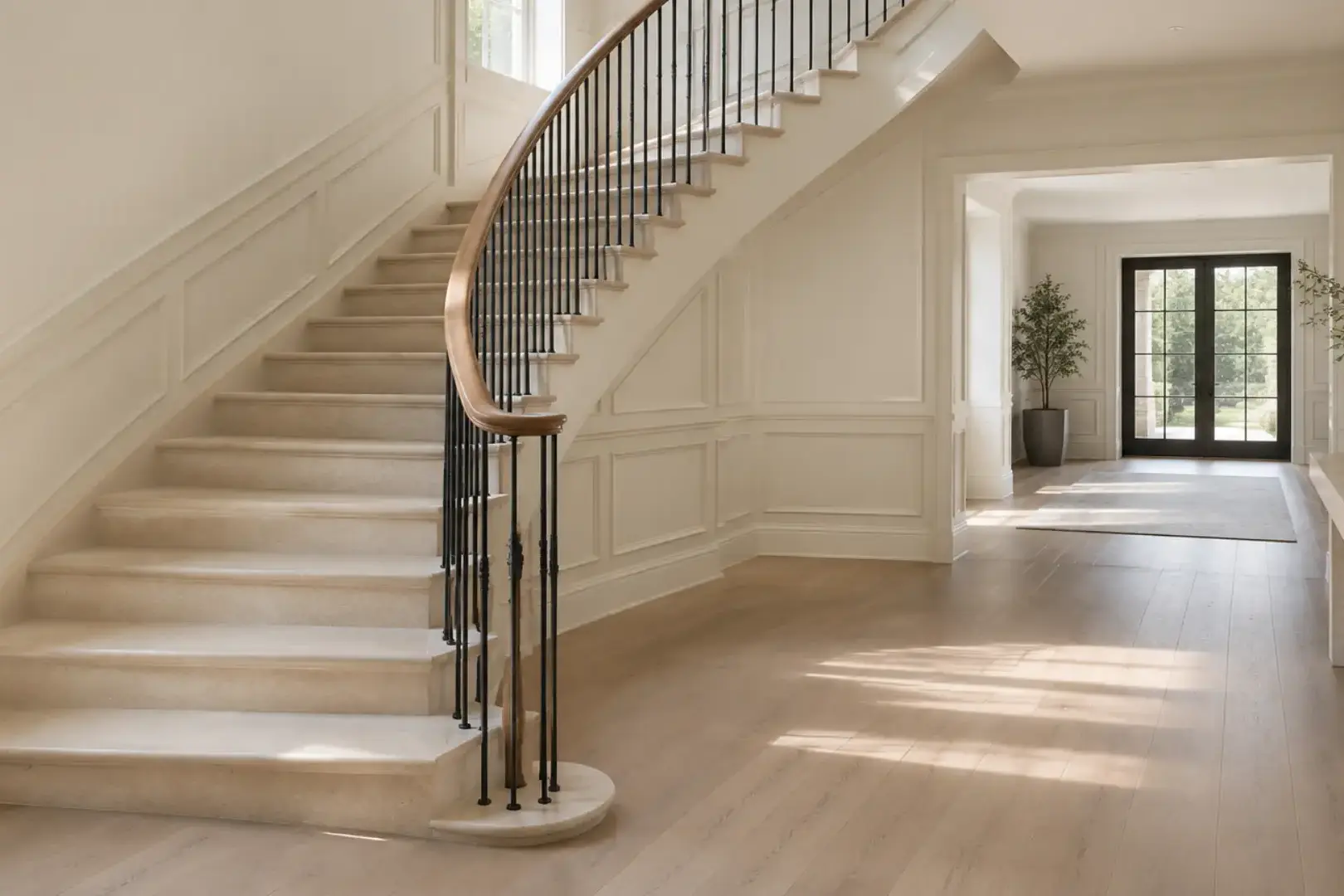
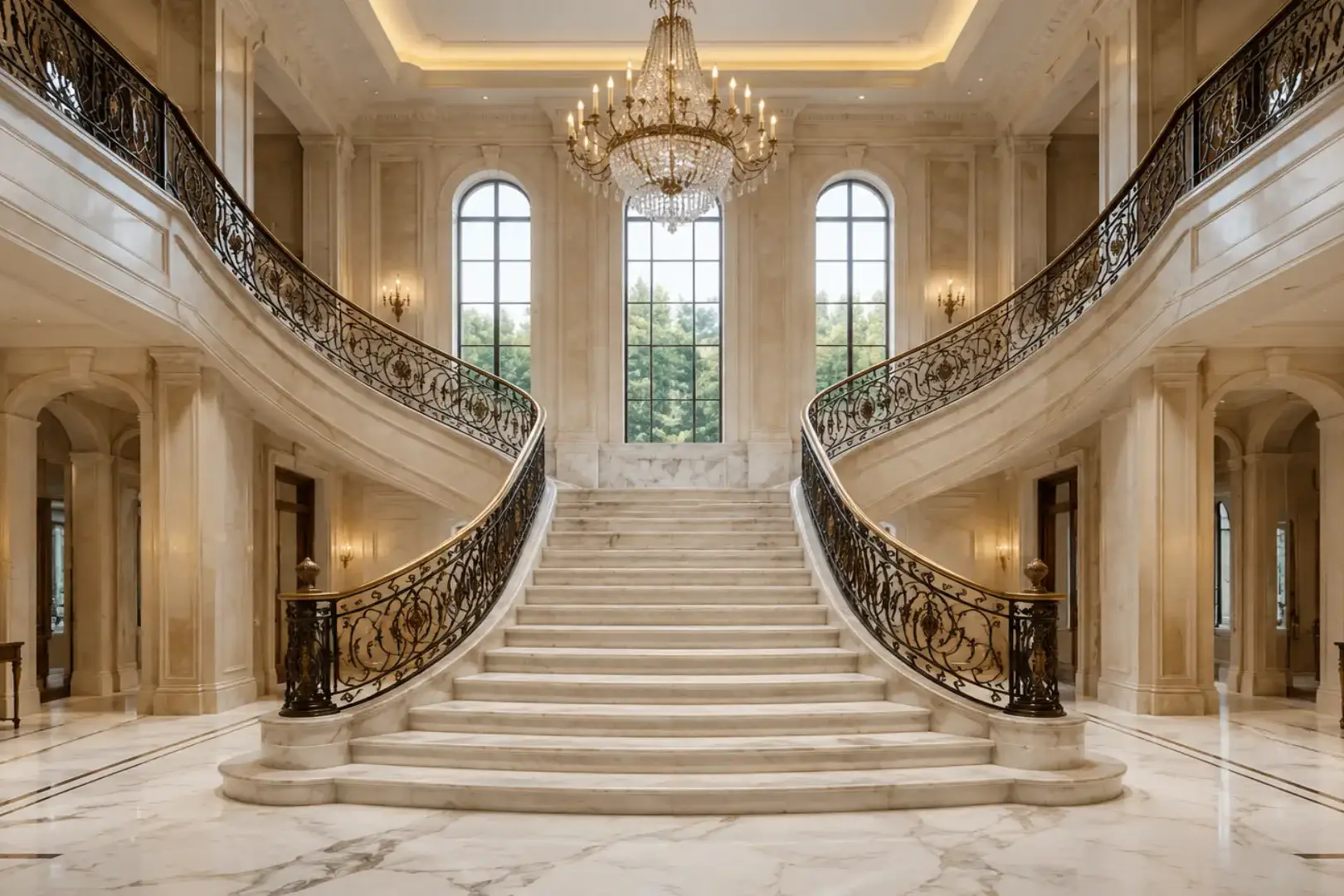
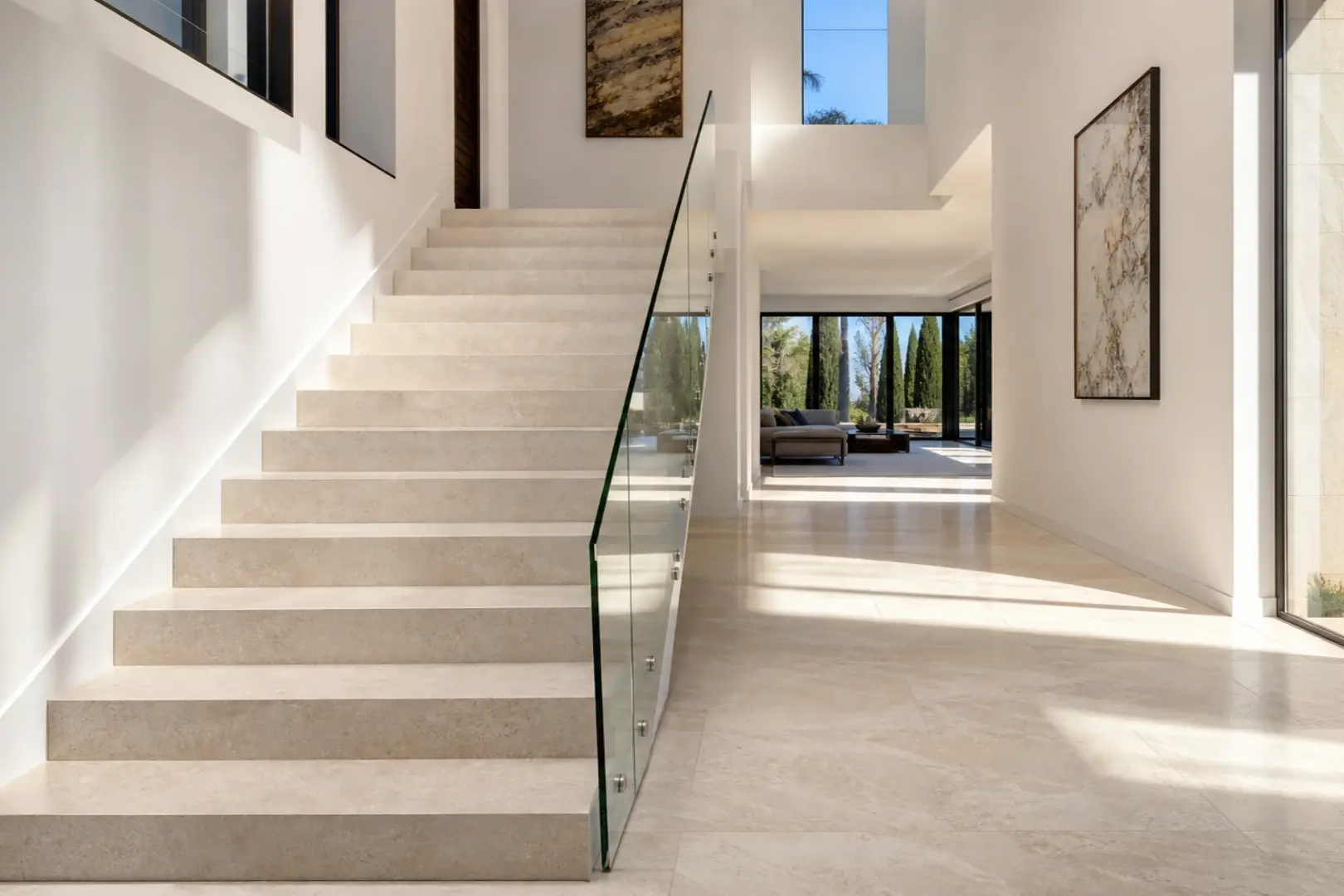
In the world of high-end residential design, few features communicate success, permanence, and artistic intent as clearly as a curved marble staircase. While a standard staircase serves a functional purpose, a custom curved design acts as the central heartbeat of a luxury home. It is a fusion of geological history and modern engineering—a feature where natural stone is transformed into fluid motion.
For high-net-worth homeowners and interior designers, the choice to include a curved marble staircase in a floorplan is rarely just about circulation. It is about creating a signature architectural moment. It is about the mastery of complex geometries and the courage to push the boundaries of what natural stone can achieve.
The Architectural Magic of the Curved Marble Staircase
When you walk into a residence, your eye is naturally drawn to the vertical circulation. A curved marble staircase doesn’t just connect floors; it guides the user through the space. Unlike rigid, angular designs, a curve softens the interior, creating a sense of rhythm that feels organic and deliberate.
This type of staircase is often referred to as a “sculptural spine.” It provides a sense of grandeur in double-height foyers and brings a touch of intimacy to open-plan living areas. Architects often choose this design when they want to avoid the “boxy” feel of standard construction. The curved marble staircase creates a visual anchor, ensuring that the luxury material is appreciated from every angle of the house.
The Engineering Reality Behind the Fluid Motion
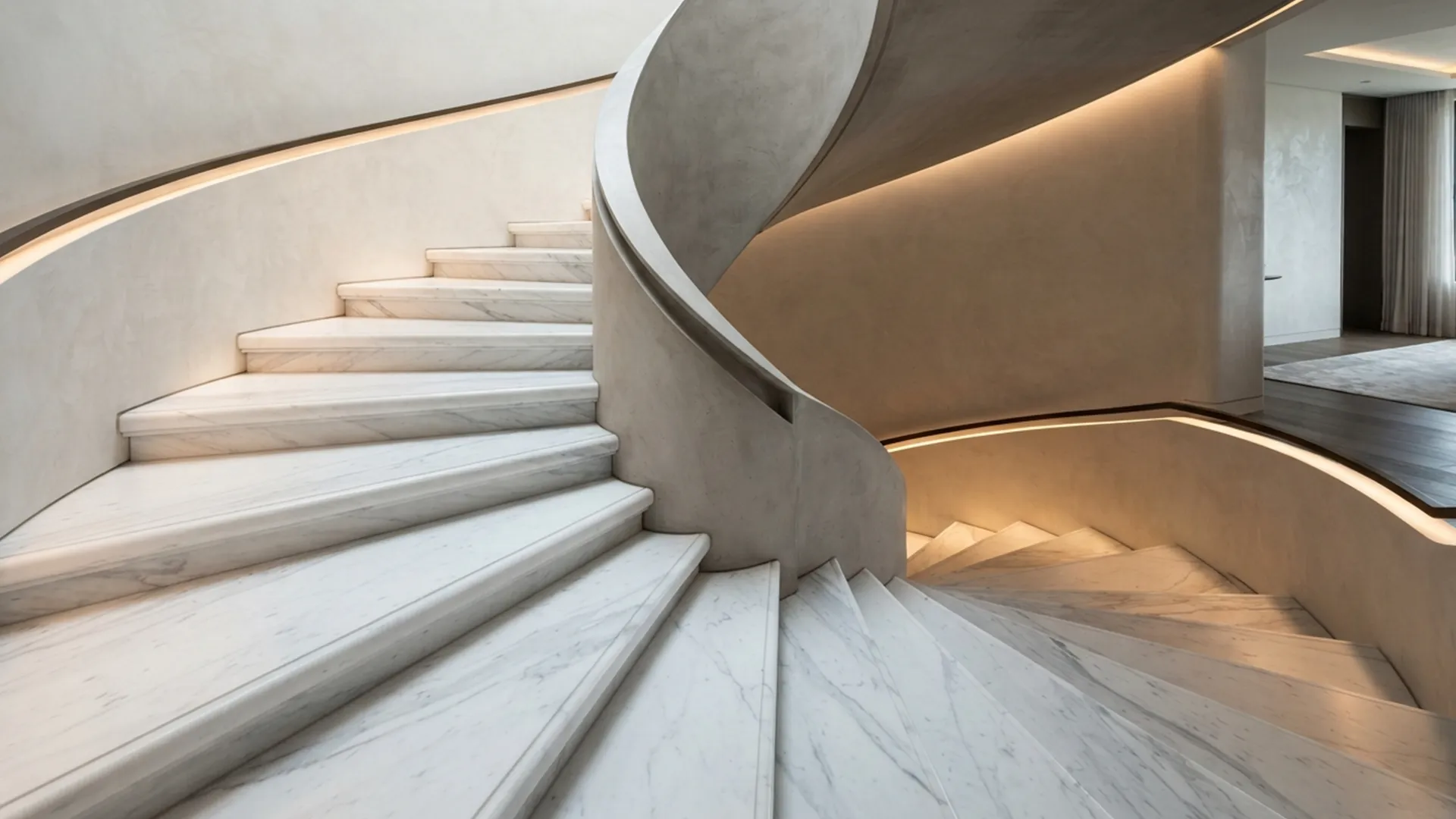
Creating a curved marble staircase that feels effortless is, ironically, an act of extreme technical complexity. Stone is inherently heavy, brittle, and rigid. Turning that rigidity into a smooth, sweeping curve requires a deep understanding of load-bearing physics, structural substrates, and geometric precision.
The engineering of a curved marble staircase begins long before the first slab is cut. It involves calculating the precise radius of every tread, ensuring that the handrail flows in a perfectly continuous arc, and managing the weight distribution across the floor assembly. In the most sophisticated projects, the stone isn’t just cladding; it is part of the structural system.
When you look at a perfectly executed curved marble staircase, you are not just seeing stone. You are seeing the result of advanced digital templating and structural coordination. It is an engineering masterpiece that masks its own complexity with pure, unadulterated beauty.
Why Fabrication Mastery Defines the Curved Marble Staircase
Fabrication is where the vision meets reality. The curved marble staircase is the ultimate test of a fabricator’s skill. Because no two slabs of marble are identical, the process of book-matching or vein-matching on a curve is exceptionally difficult.
Mastering the fabrication of a curved marble staircase requires:
- Precision CNC Routing: Using 5-axis machines to cut complex, three-dimensional curves that ensure the stone fits perfectly against the substrate.
- Vein Continuity: The ability to trace the natural movement of the stone so that the veining continues seamlessly from tread to tread.
- Edge Profiling: Ensuring that the nosing profile remains consistent throughout the entire, changing radius of the stair.
Without this level of mastery, a curved marble staircase risks feeling disjointed. With it, the staircase becomes a monolithic piece of art that feels as though it grew into the space rather than being installed in it.
Material Selection: Choosing the Right Stone for the Curve
Choosing the stone for your curved marble staircase is a critical decision. Not all marbles behave the same way under the stresses of curved fabrication.
Dense, high-quality stones like Calacatta or Thassos are often preferred for their structural integrity and aesthetic clarity. However, the choice should also be driven by the light conditions of the home. A curved marble staircase placed in a bright, sun-drenched foyer might benefit from a honed finish to reduce glare and highlight the sculptural form. Conversely, a formal, dramatic entry might call for a high-polish finish to maximize light reflection.
You can view our curated selection of materials and learn more about custom marble stair solutions at Marvelous Marble to see which stone best fits your project’s narrative.
The Technical Workflow: From Concept to Installation
The journey of a curved marble staircase is a rigorous process. It starts with the conceptual phase, where the geometry is defined, and ends with a precise installation.
- 3D Laser Templating: We use advanced laser scanning to capture the exact “as-built” conditions of the site.
- Structural Analysis: Ensuring the floor substrate can handle the immense weight of the natural stone.
- Digital Slab Planning: Mapping the veining onto the treads to ensure the “flow” of the stone follows the arc of the stair.
- Dry-Lay Assembly: Before installation, the curved marble staircase is often assembled in our workshop to verify fit and finish.
- Installation: A team of specialists installs the stone, ensuring that seams are tight and that the geometry matches the engineering specifications.
This level of rigor is what distinguishes a professional build from a common renovation. For more insights on stone standards, you may refer to the Natural Stone Institute guidelines.
The ROI of Precision: Why it Matters for High-Net-Worth Homes
Investing in a curved marble staircase is an investment in the asset value of the residence. In the luxury real estate market, architectural details that demonstrate a “no-compromise” approach to construction are highly sought after.
A curved marble staircase signals to potential buyers or future guests that the home was built with long-term vision. It provides an immediate “wow factor” that photographs well and impresses in person. Furthermore, when the staircase integrates seamlessly with other high-end features—such as stone fireplace mantels or decorative marble columns—it elevates the entire interior to a cohesive, luxury estate level.
Conclusion
The curved marble staircase is not merely a method of moving from one floor to another; it is an exercise in engineering, art, and luxury. It defines the identity of a home, shapes the movement of its inhabitants, and stands as a testament to the power of natural material when guided by expert hands.
For those in the conceptual phase of building a legacy home, there is no substitute for the grace and authority of a curved marble staircase. It remains the quintessential mark of architectural excellence.
Ready to transform your entry sequence? Connect with the design experts at Marvelous Marble to discuss your project requirements. Request your design consultation here.
In the world of high-end residential design, few features communicate success, permanence, and artistic intent as clearly as a curved marble staircase. While a standard staircase serves a functional purpose, a custom curved design acts as the central heartbeat of a luxury home. It is a fusion of geological history and modern engineering—a feature where natural stone is transformed into fluid motion.
For high-net-worth homeowners and interior designers, the choice to include a curved marble staircase in a floorplan is rarely just about circulation. It is about creating a signature architectural moment. It is about the mastery of complex geometries and the courage to push the boundaries of what natural stone can achieve.
The Architectural Magic of the Curved Marble Staircase
When you walk into a residence, your eye is naturally drawn to the vertical circulation. A curved marble staircase doesn’t just connect floors; it guides the user through the space. Unlike rigid, angular designs, a curve softens the interior, creating a sense of rhythm that feels organic and deliberate.
This type of staircase is often referred to as a “sculptural spine.” It provides a sense of grandeur in double-height foyers and brings a touch of intimacy to open-plan living areas. Architects often choose this design when they want to avoid the “boxy” feel of standard construction. The curved marble staircase creates a visual anchor, ensuring that the luxury material is appreciated from every angle of the house.
The Engineering Reality Behind the Fluid Motion
Creating a curved marble staircase that feels effortless is, ironically, an act of extreme technical complexity. Stone is inherently heavy, brittle, and rigid. Turning that rigidity into a smooth, sweeping curve requires a deep understanding of load-bearing physics, structural substrates, and geometric precision.
The engineering of a curved marble staircase begins long before the first slab is cut. It involves calculating the precise radius of every tread, ensuring that the handrail flows in a perfectly continuous arc, and managing the weight distribution across the floor assembly. In the most sophisticated projects, the stone isn’t just cladding; it is part of the structural system.
When you look at a perfectly executed curved marble staircase, you are not just seeing stone. You are seeing the result of advanced digital templating and structural coordination. It is an engineering masterpiece that masks its own complexity with pure, unadulterated beauty.
Why Fabrication Mastery Defines the Curved Marble Staircase
Fabrication is where the vision meets reality. The curved marble staircase is the ultimate test of a fabricator’s skill. Because no two slabs of marble are identical, the process of book-matching or vein-matching on a curve is exceptionally difficult.
Mastering the fabrication of a curved marble staircase requires:
- Precision CNC Routing: Using 5-axis machines to cut complex, three-dimensional curves that ensure the stone fits perfectly against the substrate.
- Vein Continuity: The ability to trace the natural movement of the stone so that the veining continues seamlessly from tread to tread.
- Edge Profiling: Ensuring that the nosing profile remains consistent throughout the entire, changing radius of the stair.
Without this level of mastery, a curved marble staircase risks feeling disjointed. With it, the staircase becomes a monolithic piece of art that feels as though it grew into the space rather than being installed in it.
Material Selection: Choosing the Right Stone for the Curve
Choosing the stone for your curved marble staircase is a critical decision. Not all marbles behave the same way under the stresses of curved fabrication.
Dense, high-quality stones like Calacatta or Thassos are often preferred for their structural integrity and aesthetic clarity. However, the choice should also be driven by the light conditions of the home. A curved marble staircase placed in a bright, sun-drenched foyer might benefit from a honed finish to reduce glare and highlight the sculptural form. Conversely, a formal, dramatic entry might call for a high-polish finish to maximize light reflection.
You can view our curated selection of materials and learn more about custom marble stair solutions at Marvelous Marble to see which stone best fits your project’s narrative.
The Technical Workflow: From Concept to Installation
The journey of a curved marble staircase is a rigorous process. It starts with the conceptual phase, where the geometry is defined, and ends with a precise installation.
- 3D Laser Templating: We use advanced laser scanning to capture the exact “as-built” conditions of the site.
- Structural Analysis: Ensuring the floor substrate can handle the immense weight of the natural stone.
- Digital Slab Planning: Mapping the veining onto the treads to ensure the “flow” of the stone follows the arc of the stair.
- Dry-Lay Assembly: Before installation, the curved marble staircase is often assembled in our workshop to verify fit and finish.
- Installation: A team of specialists installs the stone, ensuring that seams are tight and that the geometry matches the engineering specifications.
This level of rigor is what distinguishes a professional build from a common renovation. For more insights on stone standards, you may refer to the Natural Stone Institute guidelines.
The ROI of Precision: Why it Matters for High-Net-Worth Homes
Investing in a curved marble staircase is an investment in the asset value of the residence. In the luxury real estate market, architectural details that demonstrate a “no-compromise” approach to construction are highly sought after.
A curved marble staircase signals to potential buyers or future guests that the home was built with long-term vision. It provides an immediate “wow factor” that photographs well and impresses in person. Furthermore, when the staircase integrates seamlessly with other high-end features—such as stone fireplace mantels or decorative marble columns—it elevates the entire interior to a cohesive, luxury estate level.
Conclusion
The curved marble staircase is not merely a method of moving from one floor to another; it is an exercise in engineering, art, and luxury. It defines the identity of a home, shapes the movement of its inhabitants, and stands as a testament to the power of natural material when guided by expert hands.
For those in the conceptual phase of building a legacy home, there is no substitute for the grace and authority of a curved marble staircase. It remains the quintessential mark of architectural excellence.
Ready to transform your entry sequence? Connect with the design experts at Marvelous Marble to discuss your project requirements. Request your design consultation here.